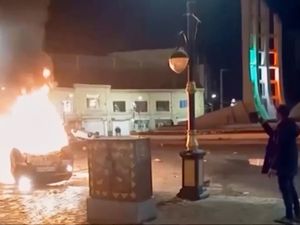
Protests in Iran have entered their second week, with escalating tensions leading to significant violence and a growing death toll. As of now, at least 65 individuals have lost their lives, and over 2,300 people have been detained, according to the US-based Human Rights Activists News Agency. The Iranian government acknowledges the demonstrations while maintaining tight control over information, further complicated by internet outages and disrupted communication networks.
With the internet largely down, assessing the scale and nature of the protests from outside Iran has become increasingly challenging. State media continues to depict a narrative of control, with reports of security force casualties alongside claims of stability in various regions. Supreme Leader Ayatollah Ali Khamenei has indicated a potential crackdown on dissent, despite warnings from the United States regarding the consequences of escalating violence.
The US government has publicly expressed its support for the demonstrators. On social media platform X, US Secretary of State Marco Rubio stated, “The United States supports the brave people of Iran.” Concurrently, the US State Department cautioned against underestimating the resolve of President Donald Trump, emphasizing that he follows through on his commitments.
As the workweek begins in Iran, many educational institutions opted for online classes amid the ongoing unrest. State television has been broadcasting a martial orchestral piece, “Epic of Khorramshahr,” composed by Majid Entezami. This music, historically associated with Iranian resilience during the Iran-Iraq War, has also been featured in videos of women protesting the death of Mahsa Amini in 2022.
Reports from state media claim that “peace prevailed” in most cities overnight, despite earlier violence attributed to armed groups. However, these assertions were contradicted by verified online videos showing significant protests in northern Tehran’s Saadat Abad area, where thousands reportedly took to the streets.
In stark contrast to state narratives, the semi-official Fars news agency, associated with Iran’s paramilitary Revolutionary Guard, released footage from demonstrations in Isfahan. This footage allegedly captured protesters firing weapons and engaging in acts of arson against government property. The Young Journalists’ Club, linked to state television, reported that three members of the Basij force were killed in the city of Gachsaran, while additional fatalities included a police officer in Bandar Abbas and another in Gilan. A security official was also stabbed to death in Hamadan, and one person was slain in Mashhad.
Amidst this turmoil, state media broadcast footage of a funeral service in Qom, attended by hundreds, reflecting the deep impact of the ongoing violence on Iranian society. As the situation continues to evolve, the international community watches closely, aware that the outcome of these protests could reshape Iran’s political landscape in the weeks and months to come.