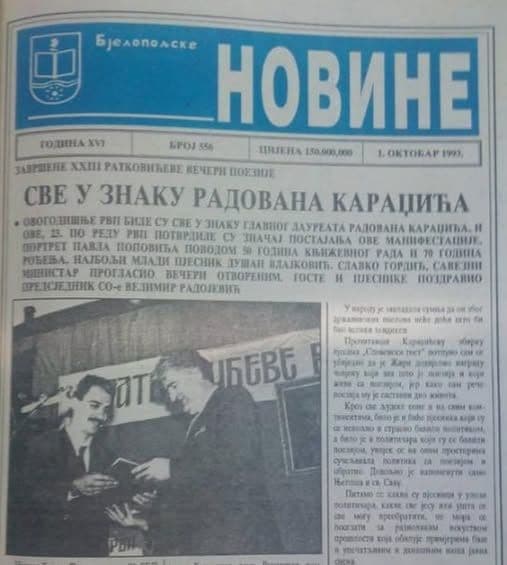
UPDATE: In a landmark decision, the literary award given to war criminal Radovan Karadzic in 1993 has been officially revoked. This significant move comes after years of public pressure and political initiatives, reflecting a renewed commitment to accountability in Montenegro.
Officials announced this urgent update on the website of the Public Institution “Ratkovic Evenings of Poetry,” where Karadzic’s name was removed from the list of laureates. Instead, a statement now clarifies that the award has been rescinded, marking a symbolic rectification of a controversial decision made during the tumultuous 1990s.
On November 6, 2025, the council of the Public Institution unanimously voted to withdraw the Risto Ratkovic Award from Karadzic, who was convicted of genocide and crimes against humanity. This decision was formalized following a resolution by the Bijelo Polje municipality on October 2, 2025.
The award was initially given just months after the gruesome abduction and murder of passengers from a train in Štrpci, events for which Karadzic, as the then-president of the Republika Srpska, bore direct political and military responsibility. The massacre included victims of various nationalities, with the youngest being just 16 years old.
Despite the removal of Karadzic’s name from the list in late August, the official reasoning was only disclosed recently, concluding a process that has lingered in the public realm for decades. The decision was met with varied reactions in the local political landscape, as some council members from the ruling parties opted to leave the chamber during the voting.
The history of the award has been marred since its inception, awarded under the shadow of atrocities committed during the war. Karadzic’s conviction for his role in the Bosnian genocide has been firmly established by international courts, which recognized his leadership role in the systematic ethnic cleansing and violence against non-Serb populations.
The move to revoke the award is seen as a critical step toward institutional responsibility, not as an act of revenge. The Democratic Party of Socialists, the party in power when Karadzic received the award, has since condemned the genocide in Srebrenica, illustrating the ongoing struggle with past narratives in Montenegrin politics.
This decision was propelled by civil society initiatives, with NGOs like CGO, HRA, and ANIMA leading the charge alongside activists. Their joint efforts culminated in a proposal that gained momentum in the Bijelo Polje Assembly, where it was approved by a majority vote.
Demir Licina, representing the victims’ families, emphasized the broader implications of this decision. “This is not just about a literary award but our commitment to the victims and the values we wish to uphold as a community,” he stated. His poignant remarks underline the emotional weight of this decision, which seeks to address longstanding grievances and the legacy of violence.
While other laureates have previously renounced their awards due to Karadzic’s association, this formal revocation signifies a critical turning point. It sends a strong message against the glorification of war criminals amidst rising nationalist sentiments in the region.
The decision arrives amidst ongoing debates about the legacy of the 1990s conflicts in the Balkans, where the denial and relativization of past atrocities are increasingly prominent. The withdrawal of this award illustrates a rare yet vital acknowledgment of the pain endured by victims of war.
As Montenegro continues to navigate its complex history, this pivotal action may serve as a foundation for future dialogues on reconciliation and collective memory. The decision, albeit delayed, showcases the importance of addressing historical injustices and fostering a culture of accountability.
As this story develops, it remains crucial for local and international observers to monitor how these changes will influence the political landscape in Montenegro and the broader Balkans.