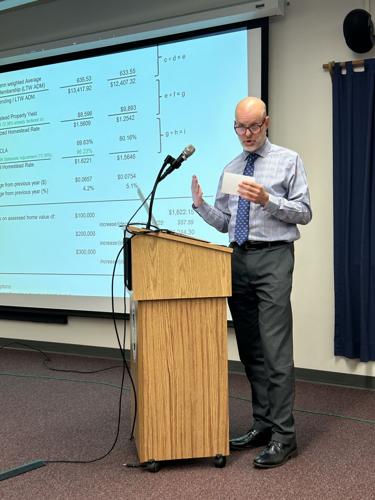
UPDATE: Newly appointed school superintendent Tim Payne addressed the Select Board in Bennington on Monday, revealing urgent insights into the complex school funding process and the potential impacts of Act 73, the state’s latest education reform initiative.
Payne’s presentation provided crucial details about how local school budgets are formed and the implications of state-level decisions on property taxes, which could affect taxpayers immediately. “Vermont has a relatively unique system,” Payne stated, emphasizing the need for transparency in the current funding structure.
The superintendent outlined the intricate steps of the budget formation process:
1. Local school boards create a budget.
2. Communities vote on the budget at Town Meeting.
3. If approved, the school board submits the budget to the state.
4. The state funds the budget from its education fund.
5. Total education spending is calculated in Montpelier, determining the funding needed for the upcoming year.
He highlighted the complicated nature of funding, where school taxes can rise more significantly than the local budget due to state calculations. The presentation included a cautionary note about the Governor’s recent decision to utilize state surplus funds to temporarily reduce property taxes, a move Payne deemed unsustainable for the future.
“This is not a long-term strategy,” Payne warned, stressing that reliance on surplus funds could jeopardize other critical state budgets. The urgency for reform is amplified by the provisions of Act 73, which aims to reshape public education in Vermont over the next five years.
Among the pivotal changes outlined in Act 73, significant milestones are set for December 1, when a redistricting committee is required to propose new school district maps. This will directly influence future tax districts and funding mechanisms. Key upcoming deadlines include the implementation of class size minimums by July 2026, the establishment of new school districts in January 2027, and the introduction of a foundational funding formula by July 2028.
Payne urged community members to engage with their elected officials about the potential outcomes of Act 73. “This could provide equal opportunities for all children in Vermont,” he noted, while also acknowledging the mixed feelings surrounding the reform. “Some believe it will save money, while others view it as a chance to improve our school facilities.”
As discussions surrounding education reform intensify, Payne’s call for community dialogue underscores the urgency for stakeholders to stay informed and involved. With the potential for significant changes ahead, local residents are encouraged to follow the developments closely, as the future of Vermont’s education system is poised for transformation.
For continuous updates, Payne recommended visiting the Southwest Vermont Supervisory Union’s website, where detailed information on Act 73 and its implications will be made available. The time for involvement is now—how Vermont educates its children could change dramatically in just a few years.