Federal agents have increasingly utilized so-called “less-lethal” weapons during immigration raids and protests across the United States. These incidents have raised significant concerns regarding the safety and appropriateness of such measures. Tools like impact projectiles, tear gas, and pepper spray have been deployed against demonstrators, particularly following the controversial shooting of US citizen Renee Good by an Immigration and Customs Enforcement (ICE) agent in Minneapolis on January 9, 2026.
The deployment of less-lethal weapons (LLWs) has sparked debate due to their potential for causing serious injuries. Although designed to incapacitate individuals without lethal force, improper use can lead to grave consequences. Reports emerged earlier this month detailing how two protesters in California were blinded when federal agents fired less-lethal rounds at them from close range.
In the wake of Good’s death, protests erupted in Minneapolis, where footage captured a Customs and Border Protection (CBP) officer firing a 40mm less-lethal launcher multiple times, seemingly targeting protesters’ faces. This action contravenes the CBP’s own use-of-force policy, which prohibits such targeting. An investigation by Bellingcat into DHS incidents in October 2025 revealed nearly 30 occurrences where federal agents apparently violated a temporary restraining order (TRO) that limited the use of LLWs.
Variations in the guidance provided to different DHS agencies, such as ICE and CBP, complicate matters. Each agency outlines different criteria regarding the level of resistance necessary for deploying specific types of force. Although the CBP’s use-of-force policy is publicly available, ICE lacks clear guidelines on LLWs in its current directive.
Despite repeated requests, DHS did not respond to inquiries regarding their latest use-of-force policies or the types of LLWs authorized for use. The DHS policy, last updated in February 2023, stipulates that officers may only use force, including LLWs, when no safe or reasonable alternatives exist. Furthermore, it mandates that agents apply only an “objectively reasonable” level of force given the circumstances they face.
DHS has consistently defended its actions, asserting that it employs riot-control measures to uphold the rule of law and ensure the safety of its officers. The following sections detail various types of less-lethal weapons that have been observed in use during recent operations.
Types of Less-Lethal Weapons Deployed
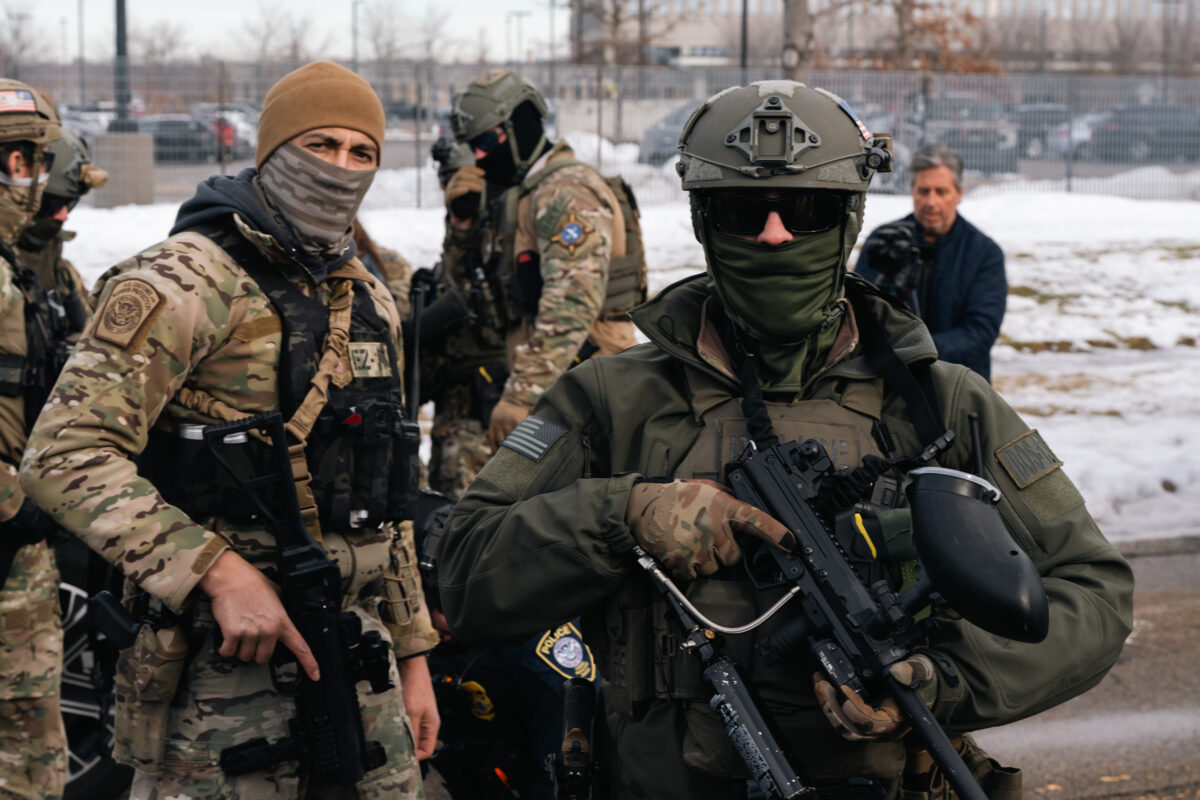
One common type of LLW is the compressed air launcher, often referred to as “PepperBall guns.” These devices, which resemble paintball guns, fire projectiles that burst upon impact, releasing irritants like oleoresin capsicum (OC) or PavaPowder. Many of these launchers are brightly colored to differentiate them from lethal firearms. The TAC-SF PepperBall is one such model, featuring a visible hopper and a compressed air tank.
Another type of LLW in use is the 40mm launcher, which can fire various munitions, including “sponge” rounds that cause pain compliance through impact and chemical irritants. Footage from protests indicates that federal agents have employed the B&T GL06 40mm launcher, which is designed to disperse irritants while minimizing serious injuries. DHS’s 2021 policies state that the use of these launchers is restricted; agents are instructed not to target vulnerable areas like the head or neck.
Hand-thrown munitions also remain a staple in federal operations. These include flash-bangs, smoke grenades, and tear gas canisters. The deployment of these devices can create confusion and limit visibility, with some containing chemical irritants that exacerbate discomfort.
Concerns Over Authorisation and Policy Compliance
The lack of a uniform policy across DHS component agencies raises concerns regarding the oversight and training of personnel using LLWs. For instance, while CBP requires annual recertification for agents using PepperBall guns, ICE does not have similar training requirements. This inconsistency can lead to dangerous situations where agents may deploy LLWs inappropriately.
A report from the US Office of Inspector General highlighted the varied guidance surrounding 40mm launchers. ICE considers these launchers to constitute deadly force when aimed at individuals, whereas the CBP employs a more lenient approach, mainly barring direct targeting of the head and neck.
Chemical irritant sprays, commonly known as pepper spray, are also widely utilized by federal agents. These sprays contain varying concentrations of irritants and are classified by their size and potency. The effectiveness of these sprays depends largely on their chemical composition and the method of dispersion.
The use of electronic control weapons (ECWs), commonly referred to as TASERs, has been observed in immigration-related raids as well. These devices deliver electric shocks to incapacitate individuals and are designed to be clearly distinguishable from firearms, often featuring bright colors.
As the debate over the use of less-lethal weapons continues, the incidents involving federal agents raise critical questions about accountability, training, and the policies governing their deployment. The actions of the DHS and its component agencies will likely remain under scrutiny as advocates and lawmakers call for clearer guidelines and greater oversight.