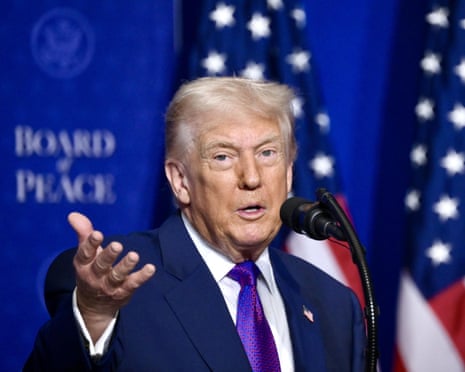
The United States has announced plans to lead a multinational peacekeeping force in postwar Gaza, featuring troops from countries including Albania, Indonesia, Kazakhstan, Kosovo, and Morocco. This initiative was unveiled during the inaugural meeting of Donald Trump’s newly formed Board of Peace in Washington, which has faced significant international scrutiny. The proposed strategy hinges on the complete disarmament of Hamas and seeks cooperation from Israel, raising questions about the board’s ability to achieve its ambitious goals of conflict resolution and Gaza’s reconstruction.
During the summit, which included notable figures such as Kazakhstan’s President Kassym-Jomart Tokayev and FIFA President Gianni Infantino, Trump announced a commitment of $10 billion from the United States to fund reconstruction efforts in Gaza. He characterized this investment as a modest step towards “bringing lasting harmony to a region tortured by centuries of war, suffering, and carnage.” Additional contributions include $7 billion from Azerbaijan, Bahrain, Kazakhstan, Morocco, Qatar, Saudi Arabia, and the United Arab Emirates, alongside $2 billion from the United Nations and $75 million from FIFA.
Trump expressed his vision for Gaza, stating, “We’re going to straighten out Gaza, we’re going to make Gaza very successful and safe.” He emphasized a broader mission, suggesting that the multinational force could address other global hotspots if necessary. Major General Jasper Jeffers III, appointed to lead the proposed International Stabilisation Force (ISF), outlined plans for deploying 20,000 troops across five sectors in Gaza, starting in Rafah. He indicated that the long-term goal includes establishing a police force of 12,000 officers, with Egypt and Jordan expected to provide training.
Indonesia’s President Prabowo Subianto expressed readiness to contribute up to 8,000 troops, indicating strong support from Southeast Asia. However, concerns have emerged regarding the ISF’s operational framework, including the absence of clear rules of engagement and the political challenges that may hinder reconstruction efforts. Reports have highlighted frustrations among aid workers associated with a board-established organization, the National Committee for the Administration of Gaza, due to a lack of direction.
Plans outlined by Yakir Gabay, a Cypriot-Israeli billionaire leading reconstruction efforts, include the removal of over 70 million tonnes of rubble and unexploded ordnance, as well as the transformation of Gaza’s coastline into a “new Mediterranean Riviera” featuring 200 hotels and potential islands. These ambitious projects are contingent upon the full disarmament of Hamas.
The Board of Peace has faced criticism for its composition, described by some as a shadow United Nations, with key European allies, including the UK, France, and Germany, opting not to participate. The Vatican also announced it would not be involved. Israeli Prime Minister Benjamin Netanyahu did not attend the meeting, with his Foreign Minister Gideon Sa’ar reiterating Israel’s security concerns and the necessity of disarming Hamas and Islamic Jihad.
Trump’s remarks during the summit included reflections on his administration’s past military actions, claiming success in bringing peace to the Middle East through strikes on Iran’s nuclear facilities. He hinted at potential future actions, stating, “Now we may have to take that a step further, or we may not. Maybe we’re going to make a deal.”
As the meeting concluded, the international community remains watchful of how these proposals will develop, particularly given the complexities surrounding Gaza’s reconstruction and the ongoing geopolitical dynamics in the region.