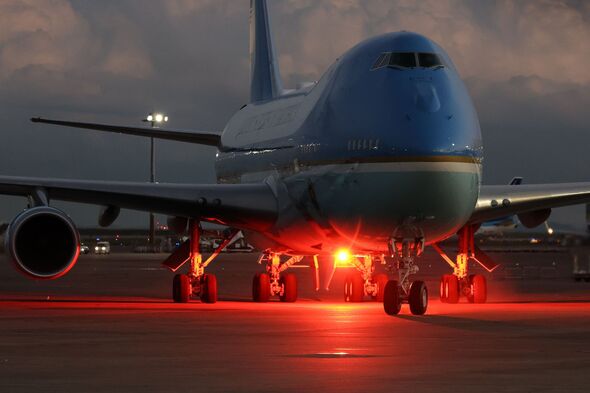
Tensions between the United States and Russia have escalated, prompting the mobilization of former President Donald Trump’s emergency command aircraft, the Boeing E-4B Nightwatch. The plane was relocated to Washington DC on the evening of March 5, 2024, amid rising fears of a potential global conflict. This aircraft serves as a crucial command post for senior officials during serious crises, including nuclear war scenarios.
Flight tracking data noted the E-4B departing from Omaha, Nebraska, at approximately 16:50 ET and arriving at Camp Springs, a military base in the capital’s suburbs, roughly three hours later. While the E-4B frequently operates across various locations, this specific movement occurs within a context of heightened geopolitical stress.
The urgency behind the E-4B’s relocation follows a series of provocative events. Recently, U.S. special forces executed a significant operation in Venezuela, capturing the country’s leader and transporting him to New York for indictment on drug-related charges. Additionally, the United States seized the oil tanker Marinera, which was flying the Russian flag and had previously evaded a U.S. naval blockade. This action prompted outrage from Moscow, with a spokesperson asserting that “no state has the right to use force against vessels duly registered in the jurisdictions of other states,” as outlined in the UN Convention of the Law of the Sea.
The Kremlin responded sharply to the seizure of the Marinera. Andrei Fedorov, a Kremlin adviser and former deputy foreign minister, warned that such actions would be viewed as an “attack on Russia,” potentially leading to a crisis in U.S.-Russia relations. He elaborated on a BBC Radio 4 program, indicating that Russian submarines were heading towards the tanker to escort it but would refrain from engaging U.S. forces directly, citing the possibility of “technical difficulties” like minor collisions.
The operational readiness of the E-4B Nightwatch is critical to the United States’ military strategy. Designed as an airborne national command post, the aircraft ensures command continuity across various scenarios. Its significance extends beyond nuclear strategy; it has also been employed domestically, such as supporting FEMA personnel and acting as a command center during emergencies like Hurricane Opal in 1995.
While the E-4B Nightwatch is based at Offutt Air Force Base, its role in national security necessitates frequent deployments to other sites, including Kelly Field in Texas and Peterson Space Force Base in Colorado. The latest mobilization underscores the aircraft’s strategic importance in maintaining U.S. readiness in the face of evolving threats on the international stage.
The current geopolitical landscape remains fraught with uncertainty, as the implications of these military actions could have lasting effects on global stability. As the situation develops, the readiness and capabilities of the United States military, epitomized by the presence of the E-4B, will be closely monitored by both allies and adversaries alike.