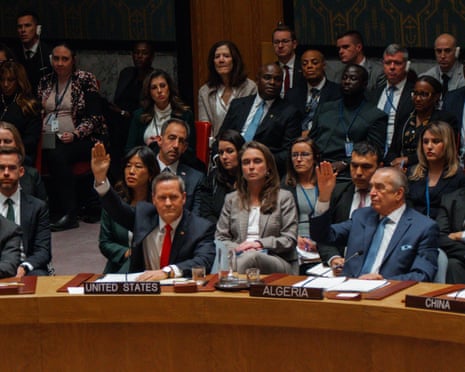
The United Nations Security Council has officially endorsed a peace plan proposed by Donald Trump to address the ongoing conflict in Gaza. The resolution, passed with a vote of 13-0 and abstentions from China and Russia, outlines a framework aimed at establishing lasting peace and potentially paving the way for a sovereign Palestinian state.
During the session, Mike Waltz, the U.S. envoy to the UN, characterized the resolution as a significant step towards a “new course in the Middle East” that would benefit both Israelis and Palestinians. The resolution’s reference to an independent Palestinian state was essential for garnering support from Arab and Islamic nations, which are expected to contribute to an international stabilization force.
Despite the resolution’s passage, Benjamin Netanyahu, the Israeli Prime Minister, reiterated his government’s firm opposition to the establishment of a Palestinian state, casting doubt on Israel’s willingness to comply with the UN’s proposals. Supporters of the resolution assert it should facilitate the immediate lifting of restrictions on aid to Gaza and the establishment of a stabilization force to fill the void left by the potential withdrawal of Israeli military presence.
Vague Commitments and International Responses
The resolution includes a commitment to a pathway towards Palestinian self-determination, but the language is ambiguous and conditional. It stipulates that the Palestinian Authority must undergo reforms and that reconstruction efforts in Gaza must commence before a credible pathway to statehood can be considered. While the wording was a compromise to appease various international stakeholders, it fell short of the unequivocal commitment sought by Arab and European nations.
In the aftermath of the vote, representatives from several countries expressed their readiness to accept the compromise. James Kariuki, the UK’s chargé d’affaires, emphasized the importance of implementing transitional arrangements in line with international law and promoting Palestinian sovereignty. Similarly, Amar Bendjama, speaking on behalf of the Arab bloc, highlighted that the resolution aims to create conditions for Palestinian self-determination and statehood.
Bendjama noted that the annex to the resolution underscores Palestinian rights, stating, “This resolution must be read in its entirety. Its annex is an integral part of it, and all parties must comply with it.” He emphasized that the document clearly prohibits annexation, occupation, and forced displacement.
Uncertain Implementation and Challenges Ahead
Despite the resolution’s passage, the Israeli Prime Minister’s office is reportedly grappling with internal dissent, particularly from far-right factions within his coalition that oppose any recognition of Palestinian statehood. Following the vote, Netanyahu reaffirmed his position, declaring, “Our opposition to a Palestinian state on any territory has not changed.”
This resolution marks a rare instance of unified action by the UN regarding Gaza, particularly in light of a diplomatic deadlock that has persisted for the last two years, during which over 71,000 Palestinians have reportedly lost their lives. While the resolution’s passage is a notable achievement, its effectiveness remains uncertain due to vague language and unresolved issues regarding the implementation of its provisions.
The plan provides for a “board of peace” chaired by Trump, tasked with overseeing the process, yet its composition and authority remain unclear. Although the resolution calls for the establishment of a Palestinian technocratic committee to manage daily governance in Gaza, details about its members and operational capabilities are still lacking.
Moreover, the resolution grants the international stabilization force the authority to disarm armed groups in Gaza, including Hamas, but it is uncertain whether contributing nations will agree to confront these groups directly. No country has yet committed to providing peacekeepers, further complicating the resolution’s potential impact.
Lastly, the criteria for reform of the Palestinian Authority, deemed essential for progress towards statehood, are not well-defined, leaving European diplomats urging for swift agreement on the formation of the technocratic committee to ensure effective governance and service delivery for the people of Gaza.
As the situation continues to evolve, the international community remains watchful, hoping that this diplomatic development can lead to a more stable and peaceful future for both Israelis and Palestinians.