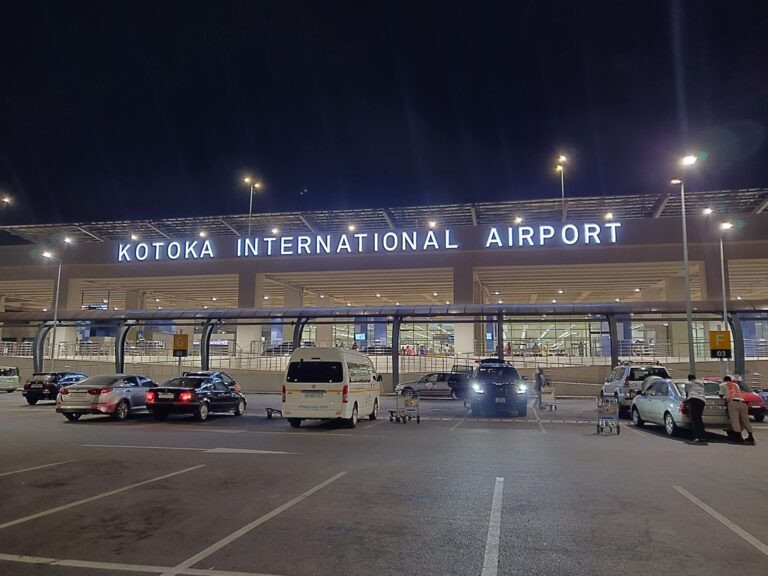
The government of Ghana has officially renamed Kotoka International Airport back to its original title, Accra International Airport, a decision that has sparked a significant national debate. This change, announced by the Ministry of Transport, comes after the airport had been named in honor of Emmanuel Kwasi Kotoka, a military officer involved in the 1966 coup that overthrew Ghana’s founding president, Kwame Nkrumah.
Transport Minister Joseph Bukari Nikpe indicated that the government “considered it appropriate” to revert to the original name in order to reflect the identity of the national capital. In local media, Nikpe emphasized that the change aims to present a more neutral image internationally.
Emmanuel Kwasi Kotoka played a pivotal role in the coup that deposed Kwame Nkrumah in 1966 and was subsequently killed during a failed counter-coup attempt the following year. In 1968, the military government honored him by renaming the airport, portraying him as a “liberator” from what they deemed Nkrumah’s increasingly authoritarian rule. Critics argue that honoring a coup leader contradicts Ghana’s democratic ideals.
Opposition to the name change has emerged from various quarters, including some civil society groups. They assert that continuing to honor Kotoka undermines the nation’s commitment to democracy and glorifies an unconstitutional shift in governance. The debate has gained traction under President John Mahama, who returned to power following the December 2024 election.
Among the critics is the minority leader in parliament, Alexander Afenyo-Markin, who described the renaming as a betrayal of the Volta Region, Kotoka’s home area. He contended that the airport’s name had been one of the few national recognitions for the eastern region.
The discourse surrounding the renaming has intensified on social media, with Ghanaians expressing divided opinions about the political, legal, and historical implications of the decision. Some have raised concerns over the financial implications of rebranding the airport, questioning why the government is not prioritizing urgent issues such as unemployment and living conditions.
Despite the controversy, the Ministry of Transport has called for public and international support to ensure a “smooth and seamless transition.” In a statement released on Monday, the ministry urged stakeholders to collaborate with relevant authorities. They also reassured travelers that the change in name would not disrupt airport operations, safety standards, or international travel.
This debate not only reflects the current political landscape but also revives discussions about Ghana’s historical narrative. In the years leading up to the 1966 coup, Nkrumah faced increasing criticism for his governance style, which opponents described as oppressive. Historians have long analyzed the role of Western powers, particularly the Central Intelligence Agency, in the removal of Ghana’s first president.
Nkrumah, who led Ghana to independence in 1957, is still regarded as a prominent figure in the pan-African liberation movement. Following his overthrow, Ghana experienced a series of military coups before re-establishing multiparty democracy in 1992. Since then, the nation has held numerous closely contested elections and maintained a record of peaceful transitions of power.
As the renaming of the airport continues to stir discussions, it remains to be seen how this will shape Ghana’s national identity and its approach to historical narratives.